
How to Measure the Value of a Customer Advisory Board
Farland Group evaluates an advisory board's value by return on time invested — for both your executives and for your customers.
Senior executives on both sides of the table are careful about where they spend their time. They approach advisory boards the way they would any serious investment — expecting a return.
When those people keep showing up, keep engaging more deeply, and start weaving what they hear into how they lead — that's compounding value. It may not fit neatly into a quarterly dashboard, but it's the kind of return that grows over time and becomes nearly impossible for competitors to replicate.
The question isn't just "what did the board produce this quarter?" It's "are we generating enough insight, trust, and strategic clarity per hour of executive time to justify — and keep earning — the investment?"
Measuring the value of a customer advisory board is one of the most common challenges program leaders face — and one of the most common questions we hear.
Executives launching or running a customer advisory board want to know: How do I prove this is working?
It's a fair question, one I've spent more than fifteen years helping companies navigate. The pressure to demonstrate ROI is real. Budgets are scrutinized. Programs compete for executive attention. And advisory boards, by their nature, don't generate the kind of clean attribution that a demand gen campaign might.
But that doesn't mean the value isn't there — or that it can't be measured. It means we need to think more carefully about customer advisory board metrics: what we're measuring, why, and for whom.
Start with time, not dollars
When Farland Group facilitates advisory board meetings, our focus is on the customer's experience — are they getting value from this conversation, not just giving it? That same orientation should apply to measurement.
Many companies track what the board produces for them: insights, strategic input, account growth. Fewer may ask the reciprocal question: what are our members getting in return for their time?
Senior executives have no shortage of demands on their time. When they choose to give it to your advisory board — and keep giving it — that choice is itself a form of measurement.
Your board members are voting with their time. If they give you time, that means they see value. When members start volunteering to host future meetings, when they engage with your team on preparation calls between sessions, when they bring their own people into the relationship — those are investments that no one makes in a program they consider a waste.
“Your board members are voting with their time. If they give you time, they see value. When your senior leaders keep coming back, that tells you something important about value creation — even before you’ve tracked a single dollar. ”
And the same is true internally. When your senior leaders see the board as worth their time and money, when they keep coming back rather than sending a delegate, that tells you something important about value creation — even before you've tracked a single dollar of revenue influence.
This is the lens I'd encourage any program leader to adopt first. Not simply, "what's our ROI?" But, "Are we collectively earning enough insight, trust, and strategic clarity per hour of executive time to justify the investment?" And that includes executive time on both sides of the table: your organization and your customers’.
The attribution trap
There will always be pressure to prove which marketing programs work — to claim precise cause/effect credit for a closed deal or a renewed contract. In marketing, this is called attribution: assigning credit to different touchpoints in the customer journey to actual sales.
Let me be direct: it will always be incredibly challenging, if not impossible, to attribute mathematically precise credit to an advisory board meeting or program. That's the nature of the program — its value is real but indirect.
What I've found over the years is that companies who get stuck on attribution often give up before figuring out the right things to measure. They either never launch the board or pull the plug on one that delivered real value, but in ways they (or their hunt for clear cause/effect) would not recognize.
Trying to measure the board this way — as you might a more discrete marketing tactic — gets in the way of identifying signals that matter.
The more productive approach is to sidestep this attribution trap — not by ignoring measurement, but by reframing what counts as evidence. The sections that follow lay out what to track and where to look.
That said, this reframing only works if the people evaluating the program are open to a broader view. This is one of many reasons we advocate CEO-level sponsorship (or as high in the organization as applies to your context). Most CEOs care deeply about what's happening with their most important customer relationships. Once you have that buy-in, the attribution argument loses some, if not much, of its power.
What can you track and when?
In our experience, advisory board value shows up in three areas, each calling for a different kind of attention.
Stronger account relationships. The board provides a unique forum for deepening executive-level relationships — understanding customers' evolving needs and demonstrating commitment to their success. Maintain a line of sight into the revenue and pipeline of member accounts. Not because the board is a sales vehicle — it absolutely is not — but because it's important to calibrate the trajectory of those relationships and whether the potential for growth continues to exist.
Sample metrics:
Increased revenue and wallet share within advisory board member accounts
Higher customer retention and loyalty rates among board members
Increased customer satisfaction scores or Net Promoter Scores (NPS) for board members
More positive customer references and case studies generated from board members
Better-informed Strategies. Board discussions can help validate, refine, or reshape strategies across product roadmaps, go-to-market plans, and business direction. The critical question isn't "how much revenue did this generate?" alone, but "how many strategic decisions were informed by what we heard?" Has board input shortened time-to-market or improved product-market fit? Those are real and trackable outcomes.
Sample metrics:
Number of strategic initiatives or decisions influenced by advisory board insights
Faster time-to-market for new products or features based on board input
Improved product-market fit and customer adoption rates for offerings shaped by board feedback
Higher win rates or deal sizes for opportunities pursued with board-validated strategies
New opportunities. Advisory board conversations regularly surface unmet customer needs, emerging trends, and potential partnerships that might not come through other channels. Pay attention to whether the board is opening doors your team didn't know existed.
Sample metrics:
Number of new business opportunities or partnerships identified through board discussions
Revenue generated from new markets, customer segments, or product lines influenced by board insights
Faster growth rates in areas of business influenced by board input compared to other areas
Improved competitive win rates or market share gains in segments targeted based on board advice
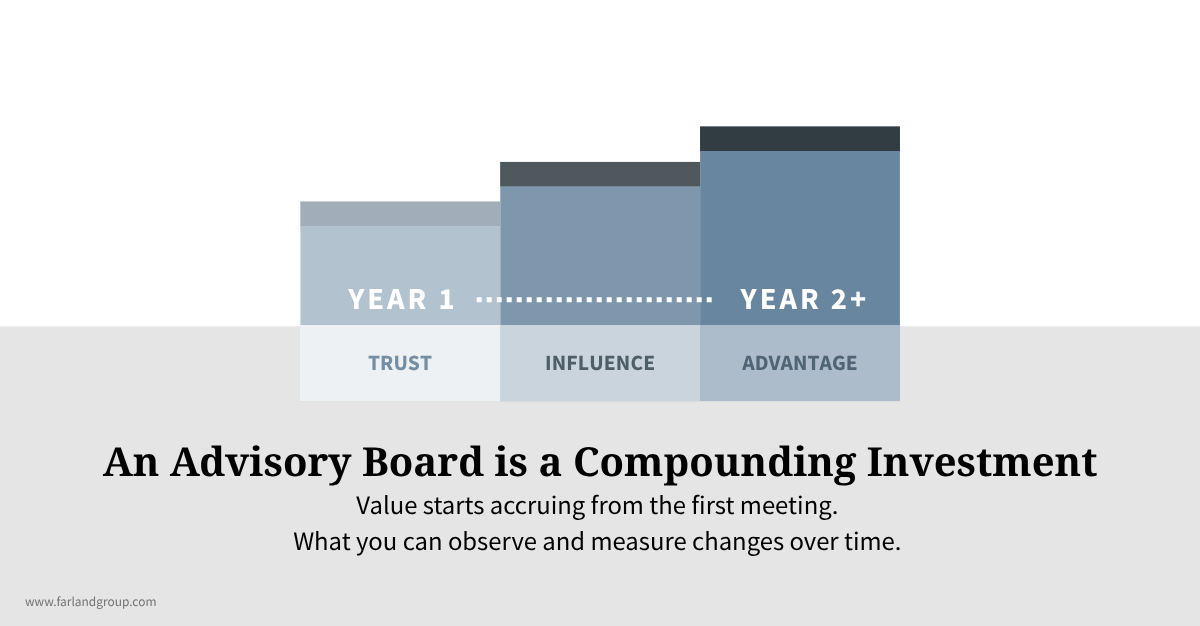
These three areas of value don't all show up on the same timeline. Value starts accruing from the first meeting. Your ability to measure it changes over time.
Some signals are visible almost immediately — engagement quality, advocacy, early wins. Others take a year or two to observe as trends — retention, satisfaction, revenue growth within member accounts. And the most durable outcomes — margin improvement, market share, a more profitable client mix — may take several years to observe and measure with confidence.
The signals that don’t fit on a scorecard
Here is where I've seen the sharpest leaders distinguish themselves. They don't rely solely on hard metrics. They learn to read a broader set of indicators — and this is where the return-on-time-invested lens becomes most powerful, because many of the strongest signals are about how people are choosing to spend their time.
Are your board members returning eagerly?
Are they engaging more deeply in meeting after meeting?
Are your own executives quoting what they heard from the board — at kickoffs, in strategy reviews, at sales enablement events?
Is the board's feedback becoming organizational currency — something leaders reference to provide legitimacy for changes they need to drive?
These signals may tell you more about long-term success than quarterly revenue attribution alone.
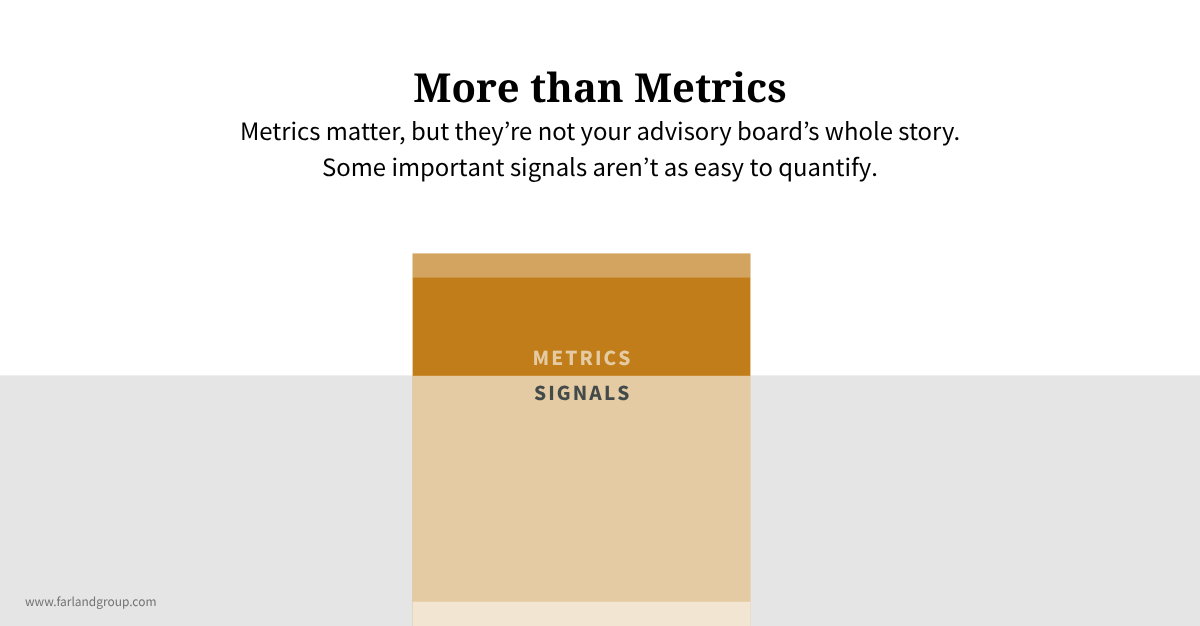
As one of our clients asserts: when a room full of your most important customers has looked your leadership team in the eye and delivered candid feedback, that carries a different weight than a satisfaction survey. And when your executives are liberally referencing that feedback across the business, you're seeing value creation in action — even if it doesn't fit neatly on a scorecard.
Another of our clients captured the compounding nature of this well: what started as relationship building with board members extended to their teams and other executives. That kind of organic expansion — almost impossible to force or accelerate — becomes more valuable over time than the original advisory insights.
Celebrate, not just measure
A CEO of a very large, publicly traded company said to me something that I've never forgotten: “Some say you are what you measure… but we seem to get results from what we celebrate."
“Some say you are what you measure...but we seem to get results from what we celebrate. ”
There's something to that. Employees who feel measured tend to focus inward — managing up, sending the right signals. Employees who are celebrated focus outward — working with customers toward wins. And customers prefer working with people oriented toward shared wins, not internal measurement rituals.
This isn't an argument for abandoning measurement. It's an observation that the culture surrounding your board — how you talk about it, whether you celebrate what it produces — may matter as much as the metrics themselves.
Three practical approaches to measuring advisory board value
Over the years, we've used a few approaches effectively with our clients.
First, co-create your measures with your customers. Focus on areas that connect to their business performance, not just yours. This isn't just a measurement strategy — it's a signal to your members that you're paying attention to their side of the equation. In most cases, helping your clients perform better leads directly to renewal and growth.
Second, measure the downside as well as the upside. We tend to focus on upside revenue opportunity, but there's real value in identifying the revenue at risk from disengaged customers — and in showing how the board helps protect those relationships.
Third, build a dashboard of actions — not just metrics. Track what advice was received, who owns each response, what timelines are in play, and what progress has been reported back to the board. This longitudinal view of action taken is one of the most powerful internal tools for demonstrating that the board's time is being honored.
Advisory board value is real, but it compounds. It resists simple attribution and rewards patient, multi-dimensional attention. The biggest mistake is letting the attribution challenge kill a program before its compounding value has time to materialize.
The companies that get this right hold both truths: measure rigorously and trust the less quantifiable signals of deepening trust, strategic influence, and people choosing — again and again — to invest their most valuable resource in your success.
That resource is their time. Honor it, track it, and the rest will follow.